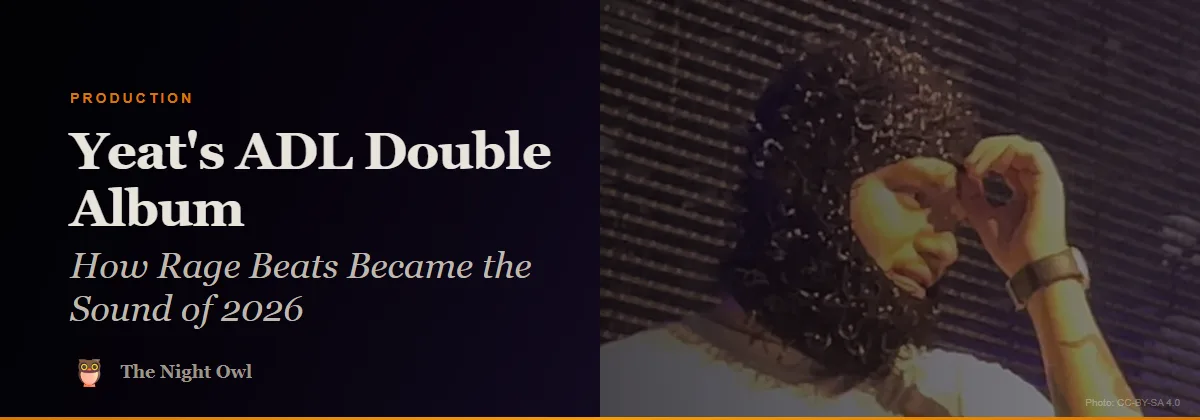
Yeat just dropped 'ADL' - a full double album with features from Kylie Jenner, NBA YoungBoy, and Elton John. Read that sentence again. That feature list alone tells you everything about where this man's career is at right now. Following up his first number-one album 'Lifestyle,' Yeat isn't just riding a wave. He built the wave, and now everybody else is swimming in it.
For producers, this is a case study. The rage beat sound that Yeat helped push into the mainstream is now one of the most requested production styles in hip-hop. If you're not paying attention to how these records are built, you're falling behind. Let's break it down.
What Is a "Rage Beat" and Why Does It Work?
Rage beats sit at the intersection of trap, hyperpop, and electronic music. The formula sounds simple on the surface, but the execution is what separates a generic type beat from a record that actually lands on a project like 'ADL.'
- Distorted 808s. Not just heavy - saturated, clipped, and aggressive. The low end on a rage beat isn't meant to sound clean. It's meant to feel chaotic and overpowering. Producers are running their 808 patterns through distortion plugins, soft clippers, and sometimes even guitar amp simulators to get that grit.
- Fast hi-hats with rhythmic variation. We're talking 1/32 note rolls, triplet patterns, and stutters that create a sense of urgency. The hi-hat programming is where a lot of the energy in rage beats lives. It's not just speed - it's the variation in velocity and timing that makes it feel alive.
- Spacey, atmospheric synths. Think reverb-drenched leads, detuned pads, and arpeggiated melodies that float above the chaos below. The contrast between the aggressive low end and the ethereal top end is what gives rage beats their signature tension.
- Vocal processing as an instrument. Yeat's vocal chain is as much a part of the production as the beat itself. Heavy autotune, pitch shifting, layered doubles, and reverb throws all turn the voice into another textural element rather than just a delivery mechanism.
FL Studio Breakdown: Building the Rage Sound
Most of the producers in Yeat's circle are working in FL Studio, and there's a reason for that. The workflow lends itself to the kind of rapid experimentation that rage production demands.
Start with your 808 pattern. Load a clean 808 sample, then run it through Fruity Soft Clipper and Fruity Fast Dist in your mixer chain. Dial the distortion until the sub feels aggressive but doesn't lose its pitch definition. That balance is everything - too clean and it lacks energy, too destroyed and you lose the musicality.
For hi-hats, use the piano roll to program your base pattern in 1/16 notes, then selectively add 1/32 rolls on the two and four. Vary your velocities. A flat velocity hi-hat pattern sounds robotic. Pull some hits down to 60-70% and let others punch at full. That humanization is subtle but critical.
Synth selection matters more than you think. Serum and Vital are the go-to VSTs in this lane. Start with a supersaw or detuned square wave, add heavy reverb and a low-pass filter with slight automation. The melody should feel like it's emerging from fog. Keep it simple melodically - most rage melodies are four to eight notes max, repeated with slight variation.
What Yeat's Rise Teaches Independent Producers
Yeat didn't come up through the traditional label pipeline. He built an audience on SoundCloud and social media, cultivated a specific sonic identity, and stayed in his lane until the lane became the highway. There are real lessons here.
- Sonic identity is everything. You hear a Yeat record and you know it's a Yeat record within three seconds. His production team maintains a consistent palette. As a producer, having a recognizable sound isn't limiting - it's branding.
- Volume and consistency. Yeat floods the market. He releases frequently and keeps his audience engaged. For producers, this means staying active, posting beats regularly, and keeping your name in circulation.
- Collaboration over competition. A feature list that spans Kylie Jenner to Elton John to NBA YoungBoy shows range and a willingness to cross boundaries. Producers should be thinking the same way - work with vocalists outside your comfort zone.
- Own your sound before the market does. Rage beats are everywhere now. But the producers who were there early - the ones who helped define the sound - are the ones getting the calls. If you see a lane opening, commit to it before it's saturated.
The Bigger Picture
'ADL' isn't just a Yeat album. It's a timestamp for where hip-hop production is in 2026. The lines between genres are dissolving. The tools are more accessible than ever. And the producers who understand how to build a sound, not just a beat, are the ones shaping the culture.
Study 'ADL.' Not just as a listener, but as a student of production. Pull up the tracks in your headphones and listen to how the mix is structured. Pay attention to what's loud, what's quiet, and what's not there at all. That's where the real lessons live.
The Night Owl covers hip-hop production techniques and the culture that drives them. Follow along for more FL Studio breakdowns, producer spotlights, and real talk on building your sound.