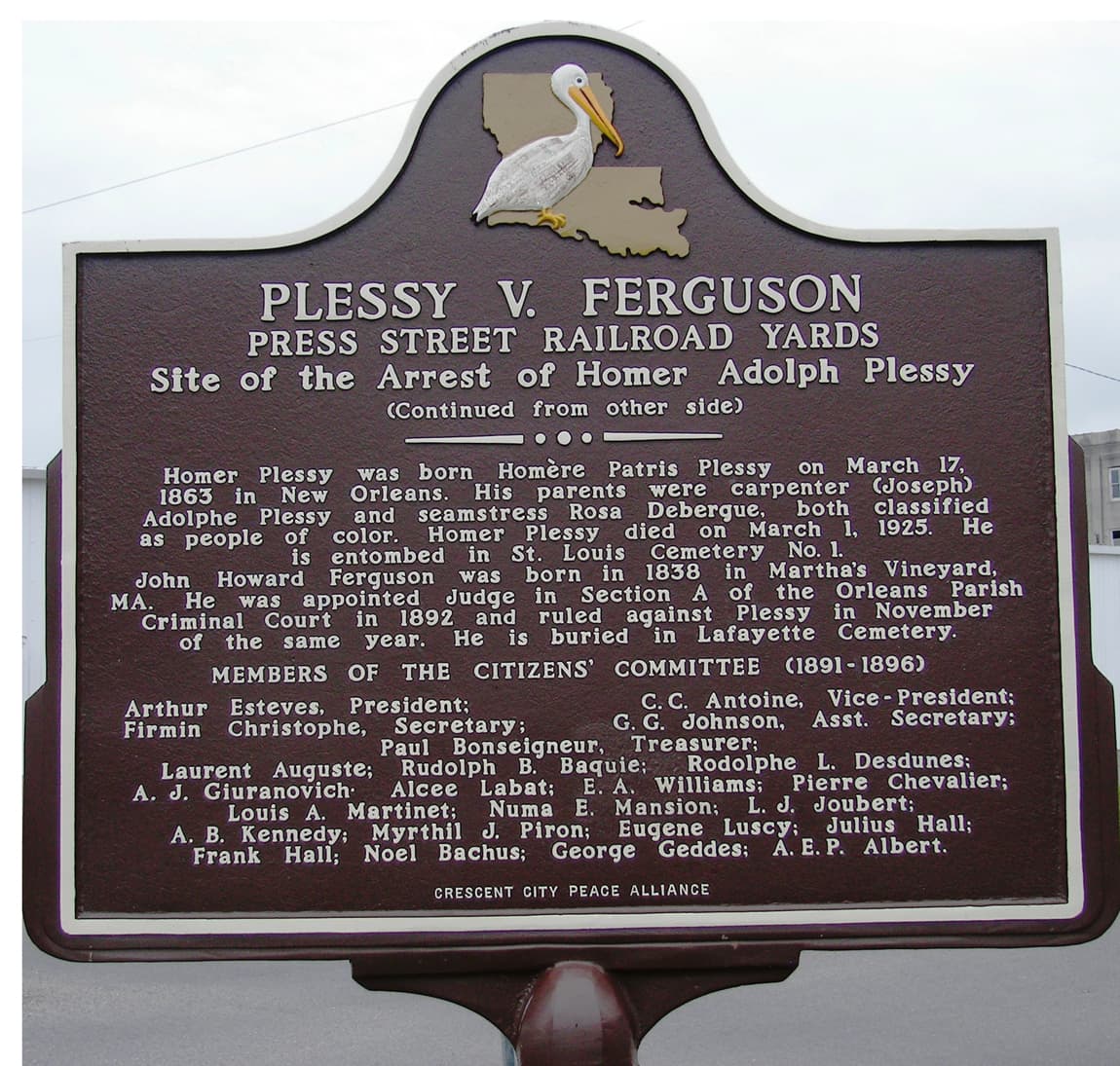
June 7, 1892. New Orleans. A 30-year-old shoemaker named Homer Plessy gets on the East Louisiana Railway at the Press Street Depot and takes a seat in a whites-only car. He's light-skinned. Most of the car probably doesn't notice. The conductor — a man named Dowling — has been told what to do.
He walks up. Asks if Plessy is a colored man. Plessy, by arrangement, says yes. Dowling tells him to move. Plessy refuses. A private detective hired specifically for this moment — Christopher Cain, working on behalf of a New Orleans civil rights group — steps in to make the arrest. Plessy is taken off the train and booked.
The whole thing took a few minutes. It was choreographed down to the conductor.
That's where the story usually gets either dramatized or skipped. Both versions miss the same thing.
The Frame Schools Give You
If you went to school in this country, the version you got is roughly: Plessy refused to give up his seat. He sued. The Supreme Court ruled against him. "Separate but equal" became the law. Sixty years later Brown v. Board overturned it.
That's not wrong, exactly. It's just compressed in a way that strips out the most interesting part of the story — which is that Plessy and the people backing him knew they were probably going to lose. They did it anyway. And the reason is the part nobody teaches.
They Were Running a Play
The play was simple. Take a law on the books, find a person willing to break it on purpose in a way that forces the legal system to either back the law or back away from it, then use the trial to put the entire system on record.
Plessy wasn't a man who happened to wander into a fight. He was a member of the Comité des Citoyens — the Citizens' Committee — a group of mostly Creole Black New Orleanians who came together specifically to challenge the 1890 Separate Car Act. They worked with a New York lawyer named Albion Tourgée, a Reconstruction-era radical who'd already built one of the most important civil rights legal records of the century. The railroad was a willing party — they didn't actually want to enforce segregated seating because it cost money to maintain separate cars. The conductor was tipped off. The detective was hired by the comité. The arresting officer knew the deal.
This wasn't civil disobedience as accident. It was civil disobedience as engineering.
They picked the plaintiff — Plessy was light enough to test the absurdity of racial classification. They picked the venue — Louisiana, where Reconstruction had been most ambitious and where the rollback was most cynical. They picked the law — separate cars, narrow enough to force a clean ruling. They picked the timing.
And they wrote the brief that the Supreme Court would later refuse, the one Tourgée delivered, that said the very logic of "separate but equal" was incoherent on its face. Read it now. It reads like it could have been delivered in 1956.
They Lost. So What Did They Actually Do?
The 1896 ruling went seven to one against them. Justice Henry Billings Brown wrote the majority — separation didn't imply inequality, segregation was within the police powers of the state, the colored man's "feelings" were not a constitutional concern. The lone dissent came from John Marshall Harlan. His line — "Our Constitution is color-blind" — gets quoted constantly now. In 1896, nobody listened.
But here's what the comité did, in the loss.
They got the entire constitutional rationale for segregation written down in plain English by the highest court in the country. A rationale that, once on paper, could be quoted, dissected, and dismantled — which is exactly what Thurgood Marshall and the NAACP would do sixty years later. Every brief in Brown v. Board references Plessy. They had to reference it. Plessy made the system explain itself in writing.
They forced Justice Harlan to write that dissent. The dissent matters because it preserved a constitutional minority position. It said, on the record, that someone on the court understood the issue. That's how dissents work. They're letters to future judges. Marshall read Harlan and wrote his briefs into the dissent's frame.
They shifted what civil rights litigation looked like. Engineered test cases, picked plaintiffs, narrow legal questions, national counsel, friendly press — that's the model the NAACP Legal Defense Fund used for the next century. The comité didn't invent it from nothing, but they ran it as cleanly as anyone had.
A loss that gets your opposition's logic written into the public record is a loss that's also a setup. They lost the 1896 case. They didn't lose the war. They handed the next generation a board with the pieces already arranged.
What "Plessy Lost" Actually Erases
When you reduce the case to "Plessy lost, MLK won," you're collapsing sixty years into a footnote. You're also erasing a lot.
You're erasing the comité itself. Most people who know the case have never heard the name. The organizing infrastructure that made the case possible disappears, which makes it feel like one man's stand instead of a community's strategy.
You're erasing the fact that this happened in New Orleans, on a real train, leaving from a real depot. There's a marker now where Plessy boarded. There's another marker commemorating the case in the French Quarter. Most people in this city couldn't tell you where either one is.
You're erasing the Black Creole specificity of the people involved. New Orleans had a long-standing free Black population with their own institutions, their own legal history, their own newspapers — the Daily Crusader carried the case in real time. The comité organized in a city with a tradition of legal challenge that nobody outside Louisiana fully appreciates. Strip that out and the case looks abstract. Inside that, it looks like the tradition it actually was — a continuation of decades of Black New Orleanian legal action going back to before the Civil War.
You're erasing Tourgée's brief, which made arguments about legal classification, racial identity, and constitutional logic that were so far ahead of their time that we'd call them postmodern now. He argued that whiteness was a kind of property the state was implicitly conferring, and that the system was a mechanism for transferring property along racial lines. Nobody on the court was ready for that argument in 1896. Most people aren't ready for it now.
The compression isn't accidental. Compression is how you teach a fight without teaching the fighters. You can fit "Plessy lost, then MLK won" on a flashcard. You can't put a hundred years of Black legal organizing on a flashcard, so the flashcard wins.
The Strategy Is the Lesson, Not the Verdict
Here's the part that bothers me most when this case gets taught.
Civil rights gets framed in school as a moral story. The good people wanted equality. The bad people wanted segregation. Eventually the good people won. The end.
That framing is technically true and operationally useless. It tells you nothing about what civil rights actually involved as a project. It doesn't tell you that the comité picked Plessy specifically because of his complexion. It doesn't tell you that the railroad was complicit. It doesn't tell you that the law had been on the books for two years before they moved on it because they were waiting for the right test case. It doesn't tell you that they failed in 1896 on purpose — meaning they knew the loss was likely, and ran the play anyway because the documentation was the point.
You can't transmit that with a moral narrative. You have to teach it as a strategy. And we don't, mostly.
Civil rights pedagogy in this country runs on inspiration. The marches. The speeches. The footage. All of which are real and matter. But the marches and the speeches were the visible layer of a much deeper organizing infrastructure that included lawyers, plaintiffs, finance, friendly judges, press contacts, sympathetic test conditions, and a long-term theory of how to get the law to break itself. The comité had that theory in 1892. They were already running a hundred-year game.
When you lose the strategy and keep only the inspiration, you produce a generation that wants to recreate the visible layer without understanding the infrastructure underneath it. Marches without litigation. Hashtags without plaintiffs. Outrage without test cases. The visible layer is downstream of the invisible one. The comité is the invisible one.
Why I'm Writing This From Louisiana
The depot Plessy boarded at — Press Street — is a few minutes from where I'm typing this. You can drive past it. There's a marker at the corner. Most days nobody is standing at it.
The marker commemorating the case in the French Quarter is similarly easy to miss. It's a plaque on a wall on a street tourists walk past on their way to a different street. Whatever your image of New Orleans is, it probably doesn't include "site of one of the most consequential pieces of civil rights litigation in American history." Tourism doesn't sell that.
I grew up here. I went to schools here. I was taught Plessy v. Ferguson the way most people are — Plessy lost, then MLK won — without being taught that the case happened in my city, on a train I could walk to, organized by a committee meeting in buildings I could go look at. I had to find that out from books that weren't in my classrooms.
That's the erasure. Not a bullet point that got skipped. The fact that an entire infrastructure of Black legal organizing existed in this city in the 1890s — a few decades after Reconstruction, a few miles from where I'm typing — was simply not on the syllabus. It got reduced to a flashcard. The flashcard got tested.
I've written before about how Louisiana shaped modern trap music and how outside frames keep flattening what the state actually exports. The same flattening is happening to its civil rights history. New Orleans is the city of bounce, jazz, gumbo, and beads. It's also the city that ran one of the most sophisticated civil rights legal operations in the country forty years before the NAACP existed. Both things are true. Only the first one fits on the postcard.
I think about that every time someone tells me Black history is being taught now and we should be satisfied. What's being taught is the flashcard. The infrastructure is still missing.
What You Do With This
A few things follow if you take it seriously.
First, lose the loss frame. Plessy v. Ferguson wasn't a loss. It was a sixty-year setup that paid off in 1954. Anybody who tells you they're not pursuing a strategy because the immediate ruling won't go their way doesn't understand how this work has historically been done. The comité didn't expect to win in 1896. They expected to lay paper somebody could pick up later. They were right.
Second, the test case is the unit. If you want to shift the law, you don't shift it in the abstract. You build a clean fact pattern, a sympathetic plaintiff, a friendly venue, and a narrow legal question. You let the system rule on it. If the system rules wrong, the ruling itself becomes the next generation's instrument. That's the shape of the work. It hasn't really changed.
Third, the visible layer is downstream. Marches, hashtags, public conversation — all of it sits on top of organizing. The civil rights wins everyone celebrates ran on lawyers and plaintiffs and money and decades of patience. If you only inherit the visible layer, you can't reproduce the wins. You can only reproduce the aesthetics of them.
Fourth, your hometown probably has more of this in it than you were told. Plessy is mine. Yours is something else. The compression that erased Plessy from my schooling is doing the same thing in someone else's city right now. There's almost certainly a comité somewhere in your local history that nobody put on the test.
The Real Story
The dramatic version of the Plessy story is that a man got on a train and refused to move. That's true. It's also incomplete in a way that hides what made the act matter. Plessy didn't just refuse to move. He'd been picked, prepared, briefed, and arrested by a hired detective on behalf of a committee that had already written the brief that would lose his case in front of the Supreme Court four years later — the brief that, in its losing, would lay the foundation for the brief that won the next round.
That's the real story. Lost cases that become next-generation foundations. Organized communities that play the long game inside legal systems designed against them. A New Orleans that doesn't get taught as a civil rights capital because the version that does get taught is shorter, simpler, and easier to grade.
Plessy didn't lose. The ruling did. The strategy worked.
Header image: the historical marker noting where Christopher Cain arrested Homer Plessy on June 7, 1892. Photo by Skywriter, CC BY-SA 3.0, via Wikimedia Commons.