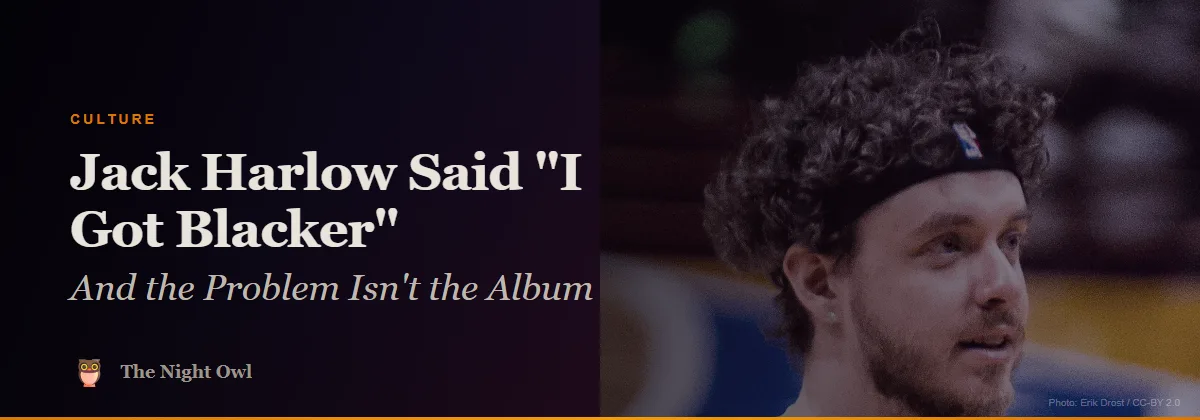
Jack Harlow went on the NYT Popcast podcast ahead of his March 2026 album Monica and said three words that told on themselves: "I got Blacker." He was describing his artistic evolution — an R&B pivot, a softer sonic palette, a record named after Monica, the R&B legend. And in his mind, that shift apparently equals getting closer to Blackness. That's the problem.
Let's be clear about what happened. Harlow didn't just make an R&B album. Artists cross genres all the time — that's music. He attached a racial identity claim to a creative decision. He framed Blackness as something he moved toward by switching up his sound. And that framing tells you everything about how he understands the culture he's been profiting from.
Blackness Is Not a Genre
This is the part that shouldn't need explaining but apparently does. Blackness is not R&B. It's not a vocal inflection or a drum pattern or a sample from a Monica record. It's a lived experience — historical, generational, structural. It's not a dial you turn up when you switch from trap beats to slow jams.
When Harlow says he "got Blacker," he's conflating proximity to Black art with proximity to Black identity. Those are not the same thing. You can study the music. You can collaborate with Black artists. You can genuinely love and respect the culture. But appreciation doesn't transform into identity. That's not how any of this works.
The backlash was immediate and it was valid. Punch from TDE responded. Charlamagne weighed in. W. Kamau Bell broke it down. Because people recognized what that statement really was — not a compliment to Black culture, but a claim on it.
The Pattern Is Older Than Hip-Hop
This isn't new. It's the same pattern that's been running since before hip-hop existed. Rock and roll was created by Black artists — Chuck Berry, Little Richard, Sister Rosetta Tharpe. White artists covered those songs, got played on mainstream radio, and became the face of a genre they didn't build. The original creators got written out of the story while their sound got repackaged for a wider audience.
Hip-hop went through the same cycle. A culture born from Black and Latino communities in the Bronx — block parties, DJing, MCing, graffiti, breakdancing — became a global commercial product. The art form that started as a voice for people who didn't have one became an industry where the people who built it often don't control the economics.
Harlow's comment fits this pattern precisely. He's not the first white artist in hip-hop, and proximity to the culture has always been a tightrope. But there's a difference between participating in a culture with respect and claiming that participation changed your racial identity. One is collaboration. The other is co-optation dressed up as a compliment.
What "Monica" Actually Tells Us
The album itself debuted outside the Top 20 — roughly 25,000 units in its first week compared to over 100,000 for his previous project. The commercial response tells its own story. But the numbers aren't really the point.
The point is that Harlow named his album after a Black woman, pivoted his entire sound toward a genre built by Black artists, and then described that pivot as him getting "Blacker." He reduced an entire identity to an aesthetic choice. And the market — the actual listeners — didn't buy it. Literally.
There's a lesson here for anyone in this industry. Audiences can feel the difference between someone who genuinely connects with a sound and someone who's performing a connection. You can hire the right producers and feature the right names, but if the framing is off, people notice. Especially the people whose culture you're borrowing from.
Why This Matters for Producers
If you make beats, you work inside a tradition that was built by Black artists. That's not debatable — it's documented history. The 808 patterns, the sample-chopping techniques, the drum programming philosophies, the entire sonic vocabulary of modern production traces back to Black innovation.
Working inside that tradition comes with a responsibility to understand what you're participating in. Not just the music theory — the context. The history. The economics of who built what, who profited, and who got left behind. You don't have to write a dissertation every time you open your DAW, but you should know the ground you're standing on.
Harlow clearly knows the music. His earlier work proved he can rap. But knowing the music and understanding the culture are two different competencies. And when you confuse them publicly — when you tell a podcast audience that making an R&B record made you "Blacker" — you reveal which one you're missing.
The Real Talk
Nobody is saying white artists can't make R&B. Nobody is saying cross-genre work is off limits. The issue was never the album. The issue is the claim. Blackness isn't something you acquire by changing your Spotify aesthetic. It's not a creative direction. It's not a vibe.
The people who responded to Harlow's comment weren't being overly sensitive. They were drawing a line that's been drawn for decades and keeps getting crossed. You can love Black music without claiming Black identity. You can be influenced by Black culture without pretending that influence flows both ways equally. The respect is in knowing the difference.
Harlow has the platform, the resources, and the talent to make whatever music he wants. But talent doesn't entitle you to identity. And the sooner the industry stops treating Blackness as a descriptor for sonic choices, the closer we get to a version of this business that actually respects the people who built it.
The Night Owl covers the culture and business of hip-hop production. Follow along for more industry analysis and real talk about the music that matters.